
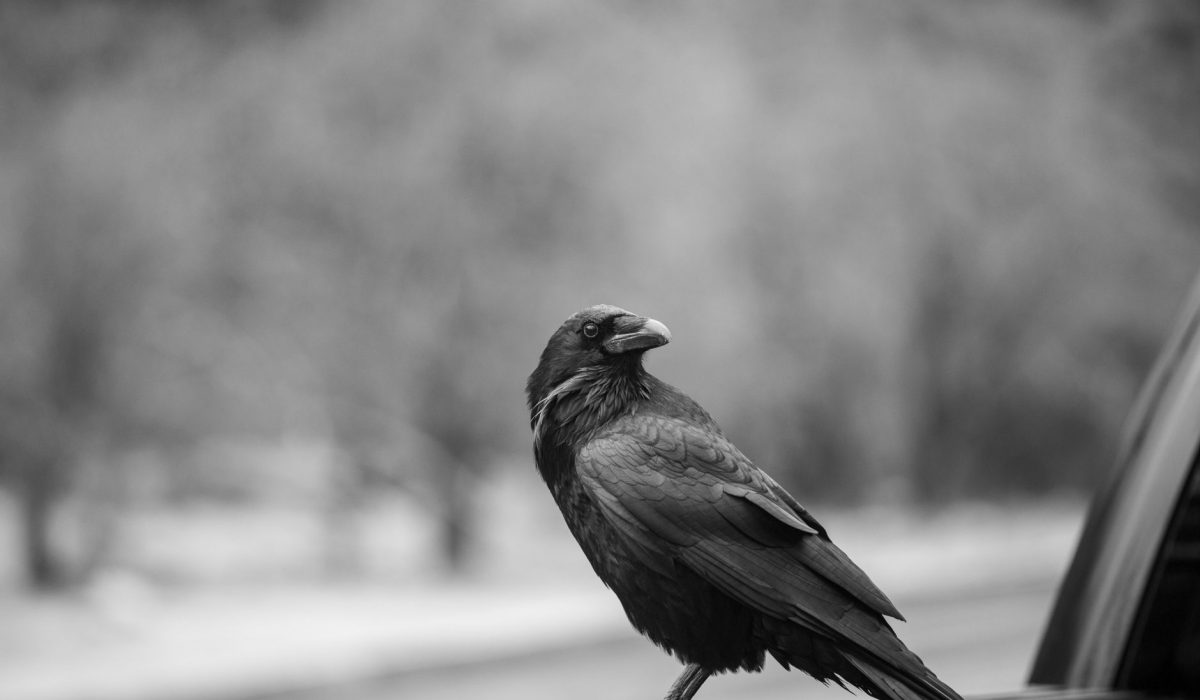
Ringed ravens on the north coast are being recorded at multiple laybys along the same stretch of road in a consistent sequence, suggesting individual birds are working a circuit rather than holding a territory in the usual way.
One bird, ringed as a juvenile in 2023, has been logged at nine separate stopping places along roughly forty miles of road, always in the same west-to-east order, and generally arriving at each shortly before the vehicles do.
Reading the road
Ravens are among the most intelligent birds in the world, with problem-solving comparable to a great ape and a well-documented ability to plan for future events rather than only respond to present ones.
Applied to a road, this produces behaviour that observers describe as unsettling. The birds respond to indicator lights. They distinguish between a vehicle slowing to park and one slowing for a passing place. At two sites they have been recorded moving toward a layby on hearing a particular engine note several seconds before the vehicle is visible.
“It is not magic and it is not affection. It is a very clever animal that has noticed a hatchback door makes a specific sound and that the sound is frequently followed by a sandwich.”
A corvid researcher
The waiting
One behaviour has been recorded repeatedly and has no obvious efficiency explanation. Birds at three sites will remain near an occupied vehicle for extended periods without approaching, in one case for over nine hours across a single day.
The working hypothesis is straightforwardly that waiting is cheap and occasionally pays.
The observations
- Laybys used by a single ringed bird: 9, across ~40 miles
- Order of visits: consistent, west to east
- Cues responded to: indicators, door sounds, specific engine notes
- Longest recorded wait at one vehicle: over 9 hours
- Effect on natural foraging: reduced at all monitored sites
The concern is the same as everywhere else in this series. A raven eating crisps is not a raven scavenging carrion, and the second is the job it does in the ecosystem.