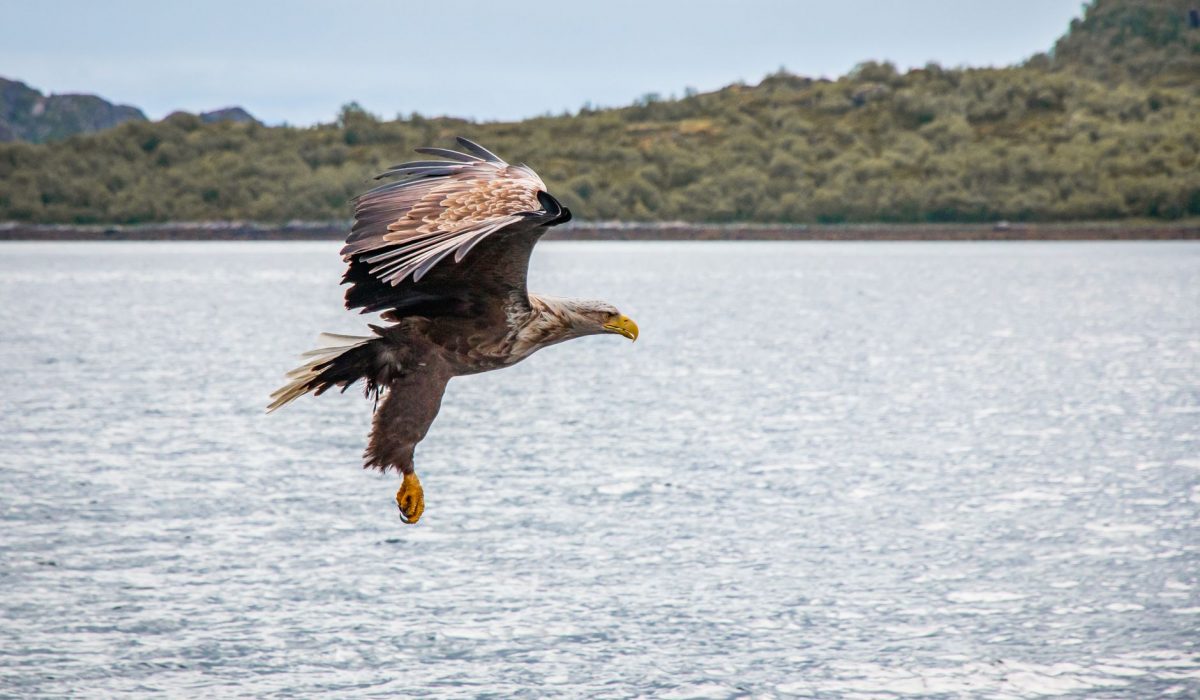
A white-tailed eagle chick has fledged successfully on the Solway coast, the first confirmed on this stretch since 2019.
The bird left the nest in early August and has been recorded making short flights within a few miles of it. Conservation staff describe the fledging as significant rather than transformative: white-tailed eagles are long-lived, slow to breed and slower still to establish, and a single chick does not make a population.
The species was hunted to extinction in Britain by 1918. Reintroduction began on Rum in 1975 with birds from Norway, and the west coast population has grown steadily since. Recolonisation of the south west has been far patchier, with pairs arriving, holding territory for a season or two, and then disappearing.
Nine hundred hours of looking at a tree
The nest was watched in shifts from April by a volunteer rota, partly to record behaviour and partly to deter egg collectors, who remain a genuine threat despite the practice being illegal for decades. The exact location is not being published.
“Nine hundred and forty hours, between all of us, in the worst spring I can remember. Most of it is nothing happening. Then something happens, and it is worth every hour of the nothing.”
A volunteer nest-watch coordinator
Adult white-tailed eagles have a wingspan of up to 2.5 metres, which makes them the largest bird of prey in the UK and, at distance, easy to mistake for a door. They feed largely on fish and carrion.
White-tailed eagles in brief
- Extinct in Britain by 1918; reintroduced to Rum from 1975
- Wingspan up to 2.5m — the largest UK bird of prey
- Diet mainly fish and carrion; they will readily scavenge
- First breeding attempt usually at four to five years old
- Legal status: fully protected; disturbing a nest is a criminal offence
The lamb question
The return of the species is not welcomed universally. Some hill farmers report losses they attribute to eagles, and the dispute over how many of those lambs were taken alive rather than scavenged after death has run for years without resolution on either side.
A monitoring scheme operating on the west coast offers advice and, in some cases, support payments to farms in eagle territory. Farming representatives in the south west have asked for the same arrangement to be extended here before the population grows further, arguing that goodwill is easier to build before a problem than after one.
For now the chick is doing what young eagles do, which is sitting in a tree looking enormous and slightly unsure. Roughly seven in ten survive their first year.